Breadcrumb

  • Home
  • The Fraud Awareness Project
  • Advance fee fraud

Search form

Main navigation

  • Home

The Fraud Awareness Project - Topics

The Fraud Awareness Project
Writers' Workshop
Courses to help you help others - Train the Trainer
What is a scam?
What is fraud?
Basics: an introduction to fraud
Advance fee fraud
Black Money Scheme
Boiler rooms
Collect and remit fraud
Communications
Cryto-investment fraud
Fraud Factories
High Yield Investment fraud
Payments Fraud
Ponzi Scheme
Pyramid Scheme
Romance Fraud
Social Engineering
Tech support etc. invoice fraud
The knock on the door
There are no pigs; there are no butchers
Victim Grooming

Advance fee fraud

The Advance Fee Fraud

There are many variations of this fraud and it seems as if there are more every day. We'll look at some of them in more detail later in this book.

For now, let's look at the factors that are common to all advance fee frauds. 

It's deceptively simple to explain simply.

Someone offers you something and says it will be sent when you pay some money.

You send the money, the thing doesn't arrive, you are asked for more money and the cycle continue until you work out the fraud or run out of money. 

It's a fee. It's paid in advance. So it's an advance fee fraud.

Now let's look more deeply

It's known by lots of names: the original global name was "the Nigerian Scam" because it began, as an organised fraud, about 50 years ago with letters posted to random people all over the world from Nigeria. It was a cottage industry but it was always, to one degree or another, organised. In the scheme, we can find the origins of today's massive fraud factories with poor workers recruited to manually write letters and address them, often using telephone books stolen from hotel rooms around the world. 

The failure rate was, of course, massive and the cost of each individual letter high. 

The fraud moved onto fax which could originate anywhere: the fraudsters could not operate their scheme with less people from anywhere: only the return point of contact mattered. The tales continued to point back to, more often than not, West Africa. 

That changed in the mid 1990s when fraudsters realised that they did not need to pretend to be an African prince or the widow of an oil industry consultant who had siphoned off millions of dollars. Geo-political factors, such as the return of Hong Kong to China presented human stories which did not need to imply a history of criminal activity. And it opened up a new class of victim: those who were driven by wanting to help someone, rather than simply to share in someone else's illegal wealth. 

That development coincided with the growth of email and that led to the industrialisation of fraud.

Millions of emails can be sent for less than the price of one stamp and in less time than it takes to walk to the post office to post a handful of letters. The marginal cost of each is incalculably small. 

Now the cost to the fraudster has shift from the production of the initial approach to handling responses. 

And that's the fundamental reason that fraud factories developed.

There's another reason, too. See Boiler Rooms for more on that. 
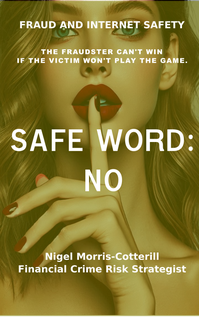
 

SAFE WORD: NO

safe word no cover

SAFE WORD: NO has one purpose: to encourage people like you to talk with your friends, family and colleagues - and those to whom you have responsibilities - to increase their awareness of fraud so as to reduce their risk.

Packed with information about fraud and how fraudsters manipulate their victims, SAFE WORD: NO is available in paperback and as "Let's Talk About Fraud" in an ebook for instant download.

Buy now

Paperback (title "Safe Word: No").

E-book (title "Let's Talk About Fraud")

More information

here


Footer menu

  • Weekly Digest (opens in new tab)
  • Images attribution (opens in new tab)
  • Corporate, privacy, intellectual property and access (opens in new tab)
  • Advertising and Recommendations (opens in new tab)
  • Promote your business (opens in new tab)
  • Enquiries (opens in new tab)

It is a breach of the terms of access of this site to cause, suffer or permit any copying, republication, framing or data scraping of all or any part of its content and is, therefore, criminal conduct. It is a breach of the terms of access of this site to use or reuse in any way any part of the content herein without express permission for which a fee may be charged and such use is, therefore, actionable in civil proceedings. The operator of any bot used in breach of these terms agrees, by entering the site, to admit to such use and to pay liquidated damages of GBP1 million in respect of each entry and, in addition, to each extraction of content, regardless of the amount extracted and the purpose of such extraction.


BOT AND SCRAPER ACCESS DENIED


Built with Drupal     |     Hosted by Siteground     |     Template by Alaa Haddad     

Design by Vortex Centrum Limited    |     Some services provided by Google Workspace    

Posters and other merch by ProjectLXX   |   Privacy and security services by Surfshark and Firetrust. 


Nothing in this website is intended to be or shall be taken as legal advice. 

You should always seek advice from a practitioner experienced in this area. 


Everything on this website is copyright Nigel Morris-Cotterill and/or Vortex Centrum Limited for itself or one of its business units. No downloading, printing or other means of replicating or reusing is permitted. In particular, all bot access is denied and all scraping of content will result in the legal action set forth in the terms and conditions in this site. For legal, cookies and privacy see vortexcentrum.com.

Copyright © 2026 Company Name - All rights reserved

Developed & Designed by Alaa Haddad
