
Ross: using parking rules to explain the limitations of "Artificial Intelligence."

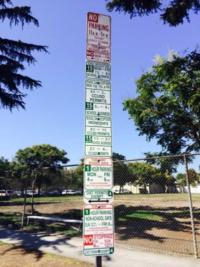
Are you confused by so many rules?
Imagine a digital sign-pole brain (AI) for all these parking rules. Assuming a parking space is open, the AI could give the driver of a car a real-time on-the-spot answer for whether it's allowed to park there (and for how long) or not.
These parking rules are behavioural rules, not inference or definitional rules, so they can be broken. For that reason, we must consider enforcement. Suppose you do park there when the digital sign-pole brain says you're not supposed to. Or time runs out on your allotted time. What should happen?
It's probably not feasible to eject the car from the spot like a jack-in-the-box. But the sign-pole brain could easily summon a tow truck. And since the sign-pole brain perceived your car's identity, it could certainly issue a (digital) parking ticket.
Could machine learning be used to implement the sign-pole brain? Yes, for the perception part of the solution. Nobody really needs any explanation for those results.
But for the cognition part?
No!
We need symbolic rules (read ‘natural language expression’) for that part because the rules must be explainable for all parties involved – including the judge if you take your parking case to court.
Behavioural rules like these parking rules are quite different from the inference and chaining* rules traditional to symbolic AI (read expert systems) in at least two ways.
1. Behavioural rules can be broken – just like laws and regulations. Actually, the parking rules are laws or regulations. So, dealing with detecting breaches and enforcement is a central (not secondary) issue.
2. Multiple parties are involved. In this example, the parties include both the driver (or driverless car) and the municipality. Behavioural rules are about directly coordinating interactions between people and communities or organisations.
* Classic expert systems used inference rules and chained them together. For example: IF A THEN B. IF B THEN C. So if A is true, you can automatically say (infer) C is true. Since A and B can be arbitrarily complex, and chains can be lengthy, complex logic can be expressed.
--------
Ronald Ross is Co-Founder & Principal of Business Rule Solutions, LLC (BRS) where he actively consults. BRS specialises in policy interpretation, business rules, decision design, concept modelling, and business knowledge engineering. Ron is creator of RuleSpeak®.
You can read more on this topic here: https://www.brcommunity.com/articles.php?id=c114
About this section
Opinion pieces or "Op-Eds" are the home-made bombs of the publishing world. So long as they meet editorial standards, are not intentionally offensive with a view to causing hurt or insult and are relevant to our field of endeavour, we will look at submissions.
We like contentious, we like contrarian views. We don't like pretty much any -ism . We recognise that Opinion pieces are one person's view and are not balanced (if they are balanced and reach a reasoned conclusion, they are probably more suited to the Articles section). We do not like acronyms and buzzwords.
To submit an Opinion piece, please complete the Contact form.
