

Admissibility of evidence obtained by foreign law enforcement: Court of Appeal (England and Wales) judgment in Murray & ors (Encrochat)

Sitting with two Judges, the Lord Chief Justice, The Lord Burnett of Maldon, was courteous but firm. The Court had not been convinced by oral argument on 1 March and immediately said that the appeals would be dismissed. On 16th March, the formal order was handed down. The reasons for dismissal will have far-reaching effects across many jurisdictions.
The appeal was an attempt to challenge whether evidence gathered from the Encrochat server was admissible in an English court.
The short answer is that it is. The long answer is far more interesting.
In late 2019, French law enforcement agencies gained access to the EncroChat system by planting malware on phones. That enabled "vast quantities of message and other data to be harvested from the EncroChat server which had been marketed as being totally secure".
Some months later, the UK's National Crime Agency was granted permission to use the evidence gathered in criminal prosecutions. "Unparalleled resources" were channelled into the prosecution of "the most serious organised crime offences."
His Lordship said "To date, there have been 950 convictions connected to the use in evidence of
EncroChat material, the majority on guilty pleas. About 1,800 defendants are awaiting trial in cases where EncroChat evidence is central to the prosecution case. Most are in custody. The substantial delay in dealing with these cases stems, in large part, from the resolution of points of principle in lengthy preparatory hearings. At their heart have been various arguments that the evidence harvested from the EncroChat server is inadmissible by virtue of the prohibition against the use of intercept evidence provided by the Investigatory Powers Act 2015."
It is not the first time that a case of the nature has been before the English courts: R v A, B, D and C came before Court of Appeal in 2021 and Lord Burnett was the senior judge on that case, too.
In that case, it was found that the the Investigatory Powers point did not arise because the data had not been "intercepted" at the time of transmission but instead "intercepted" from data stored on the phones themselves. A second argument, that the data had been extracted during transmission was found to be so unlikely that it could be safely discounted. There is an outstanding application before the Investigatory Powers Tribunal challenging the legality of the warrant that authorised the obtaining of the EncroChat material in that case. The Tribunal ended in December , 2022 but no judgment has been issued.
In R v A, B, C and D Burnett said "If it is intended to repeat this kind of process [i.e. a lengthy preparatory hearing] in other pending cases involving EncroChat material, those involved should not be surprised if the trial judges deal with them rather more briskly.” And that's what happened at first instance and now in the Court of Appeal.
That was not what the Defendants wanted. Burnett was clear: "the nature of these EncroChat cases invariably involves serious alleged offending which attracts very substantial sentences on conviction" and the defendants' collective endeavour to delay trial, using the Tribunal as a reason, was not going to cut any ice. "The defendants in this case, and others, have had years to get their cases in order. Applications for adjournments on the basis that something may turn up will not prosper."
In December 2022 after four months before HH Shetty, J, the four defendants were convicted of conspiracy to evade the prohibition in the export of a Controlled Drug (Class A) and sentenced on 6th December.
Stefan Baldauf – 28 years, with 2 years concurrent for entering the United Kingdom without
leave contrary to section 24(1)(a) of the Immigration Act 1971; Danny Brown – 26 years; Peter Murray – 24 years; Philip Lawson – 23 years. Another conspirator Tony Borg was sentenced to 15 years’ imprisonment. Borg did not appeal.
The export scheme was not simple: a Doosan excavator was bought in December, 2019 and taken to Grays in Essex. Holes were cut in the boom and it was lined with lead, intended to defeat x-rays at ports. Then about 450 kg of MDMA packed inside, the holes refilled and made good. Then they sent it to Australia. On arrival, Australian Customs identified the subterfuge, removed the drugs and, again, filled up holes and made good. Then they released the excavator through Customs and kept watch.
In Australia a fake auction was held and the excavator sold. It didn't take long for the absence of the drugs to be discovered.
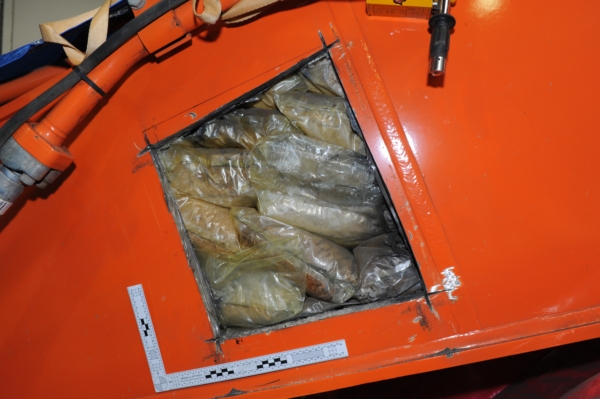
Credit: Australian Federal Police find drugs in a digger
" The initial suspicion of the conspirators was that one or more of them had taken them and betrayed the others. There were exchanges via the EncroChat system about the missing drugs and meetings between conspirators. It was not possible to retrieve any messages from December 2019, when the excavator was loaded, but messages were retrieved from
April to June 2020."

Murray was responsible for the drugs: He had a mobile phone referred to as 6666 and an Encrochat phone with the codename "Leadarrow" he was witnessed near the industrial estate in Grays and his hired van was picked up on Automatic Number Plate Recognition. When Murray was out of the country, that phone went quiet. Brown's codename was "Throwthedice" and the Encrochat data showed that he was closely involved in the export of the Doosan digger. Baldauf's codename was "Boldmove" and he and Brown were in frequent contact when the absence of the drugs was discovered.
When Murray was arrested, scales and heat sealing equipment in his yard tested positive for MDMA. The evidence obtained from EncroChat enabled the National Crime Authority to identify meeting places and to obtain closed circuit tv footage confirming the authenticity of the messages.
Brown's defence was a simple denial coupled with a claim that the evidence was not reliable because it had been corrupted during extraction.
Baldauf's defence was that he was not involved in the MDMA conspiracy because he was busy importing cannabis from Canada. He said that EncroChat had muddled up his messages about that with someone else's messages about MDMA.
Murray accepted that he owned the phone known as 6666 but denied that he had an EncroChat phone and that he was Leadarrow. His defence was, basically, that of mistaken identity and that the police really wanted to find someone called "Colin." "He said that Colin accompanied him to Grays on a key date and also borrowed the rented van. He was unable to say where Colin was."
Lawson was the fitter: he arranged for the holes to be cut, the lead to be attached, waited for the drugs to be put into the boom, for the cut-outs to be reinserted and welded in and made good. His EncroChat phone records, using the codename "Cloud" showed an integral part in the conspiracy.
The defendants' argument in relation to the EncroChat material was that an expert, a Professor Anderson, had been hampered in his work because "“the French won’t tell anyone how they did it". He was not "their" expert: he had been instructed by a claimant in the Tribunal and by a defendant, Atkinson, in an entirely different trial but he did not give evidence. . His Tribunal report was put into the trial of the present defendants by the prosecution and the Defendants given a week to file a response but failed to do so. But, while the Court was aware of the Report, it was not entered into Evidence and so was not before the Jury.
Prof. Anderson did not give evidence in the Tribunal nor in Atkinson and he has "declined to accept further instructions in EncroChat matters."
But the defence tried to argue that his report cast doubt on the credibility of the EncroChat evidence. If a judge could say "bog off," this is where he would. Instead, he said "The only paragraphs in his report to which our attention was drawn as supporting the hypothesis that the EncroChat data may be unreliable do no more than advance a theoretical possibility, unconnected with the substance of the issues in this case. Unusually, in this case Brown’s EncroChat phone was recovered in a condition which enabled the material recovered by the French authorities to be compared with that remaining on the phone. It was the same."
EncroChat was designed to delete messages from phones after a short period.
But here's the single most important point of the entire judgment: " Given that the EncroChat messaging was exfiltrated in France, we do not think that the UK's Association of Chief Police Officers' guidelines provide any further support for the argument based on unfairness or prejudice."
In short, if the evidence would be admissible in the country where the local law enforcement agencies obtain it, it will be admissible in an English Court, even though the analysis is done in England.
Further Reading: The Australian Federal Police press notice on the Australian end of the drugs seizure is here: https://www.afp.gov.au/news-media/media-releases/450kg-mdma-found-excav…
Full judgment: https://www.judiciary.uk/wp-content/uploads/2023/03/R-v-Murray-Others-2…

