How blatant does fraud have to be before social media blocks it?

The first post in my LinkedIn feed this morning was this:
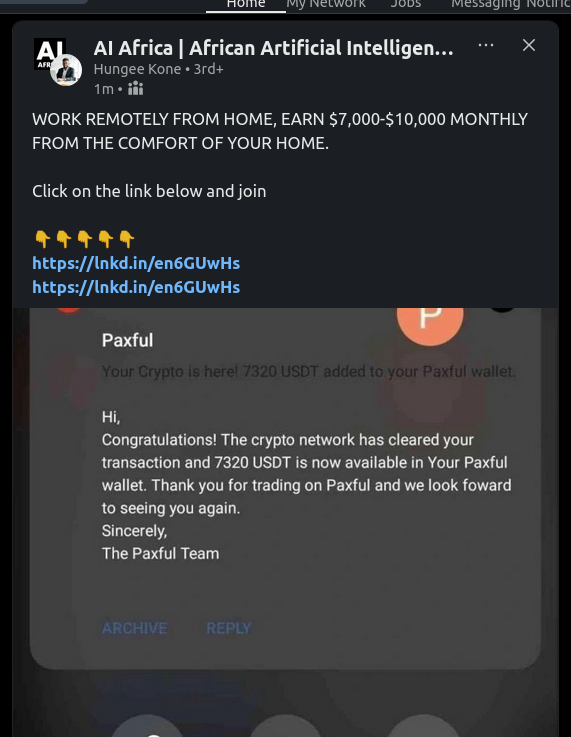
The patterns in this post include some that have been obvious and widely used for some years as a combination of organised gangs and bots follow a process. LinkedIn can't claim ignorance: I've told it.
I have reported hundreds of examples of the results of the process.
Yet, still, they come.
I got a prepaid mobile phone a few weeks ago, for a very specific, one off, purpose. The number has been issued once - to a social media platform, Carousell, for verification. I now get robocalls inviting me to get X, Y and Z by connecting via WhatsApp. I can't confirm that the number has escaped from Carousell: perhaps the mobile phone company, Digi, tells criminals when new numbers are issued or, perhaps, criminals just use autodiallers to attack all numbers (not likely or my other phone would be similarly afflicted. That's the victim of a different data breach).
But someone somewhere should know that autodiallers are using their network and if phones aren't seen as an integral part of social media by companies and regulators, they need to catch up with the way criminals think.
The Big Five and the still quite big many
If we take the view that five groups of companies dominate social media in the sense of massive scale, Google, Meta, Microsoft, Twitter and ByteDance, with a second wave of Ant Group, Amazon and other shopping platforms and market places and a raft of primarily US media outlets and inter-linked bulletin boards, we can see that control is far from impossible.
If banks etc. are required to identify, using pattern analysis and data, transactions and other activity that is suspicious, where all of that is held as data, how can it realistically be argued that the data in the hands of social media companies is fundamentally different?
It can't. The difference is simply this: the USA is constrained by the widespread misapplication of the Constitutional right to free speech. Worse, that right is illusory. It is used by extremists to claim that they can say anything they want, including lies. The cost of fighting a constitutional claim, and the bad reputation that would follow, is such that the US companies don't put any significant effort into stopping it, unless the content is so repulsive to the majority of people that allowing it would create a backlash. And the companies adopt the attitude that what they do in the US is how they should behave everywhere.
Here's the next point: we know the tech to identify fraud exists and we know most of the platforms have it. They just don't use it for fraud and in the case of marketplaces they don't use it to prevent counterfeits (which are a form of fraud, vis a vis the consumer).
They use it to block some extremist language, some images and some political views. LinkedIn uses it to identify "trigger" words that might upset snowflakes: it especially dislikes the word "idiot" which is an idiotic stance to take. Yet it is the snowflake generation that are targeted by fake job ads, crypto investment frauds etc.
The original post.
Insidious grooming
All the names that are given to fraud techniques that develop a relationship are otiose: the only one that matters is grooming. So, think of dogs not pigs, of careful relationship building, not butchering.
And on social media, the grooming often starts even before any direct relationship is formed.

Ads for healthcare products and financial services concentrate on lifestyle because they work. And fraudsters are more than happy to follow that trend. They also, as the ad at the top does, use base psychological tricks to pique the interest for a better life, where even the cynical ask themselves "where's the harm in finding out?"
Fraud is a mind game. Literally. The fraudster pits his wits against those of the victim.
But it’s social media that often creates that opportunity because social media depends on the false use of the term “friends.” How often do you read a post that starts “hello LinkedIn Fam”? Boundaries have not been breached, they have been overrun.
Cop to it instead of copping out
Social media companies say they apply "community standards" . This means they don't want to police content but will act if someone complains. First, this means that complaints tend to come from "activists" who think their view is right and everyone else's is wrong - for example, accounts which are closed because someone felt insulted. But should it be left until someone has been harmed - which is when a complaint is most likely to be made - rather than to be preactive and vet promos (which it, of course, what most posts are) before they are published. Like a proper publisher would have to?
Social media companies must be made to face up to, accept and deal with their part in what some are calling the world's third, or more, biggest industry.
Nigel Morris-Cotterill is the author of SAFE WORD: NO, a book to help families and social groups to treat fraud awareness and avoidance as part of everyday life.